The Watercolors that Modern Art Won’t Talk About
When we think of modern art, watercolor probably isn’t the first medium that comes to mind. We associate modern art with Picasso’s fractured figures, Mondrian’s geometric grids, Pollock’s explosive drips, Kandinsky’s floating shapes, and Chagall’s dreamlike lovers and musicians. We discuss these famous artists in the context of painting, abstraction, and the major movements that transformed modern art history. But there is another side to their work that deserves attention: their use of watercolor. All five artists created works on paper using watercolor, or watercolor combined with other water-based media.
Looking at these works offers a fascinating perspective on art history. It shows us that the development of modern artand abstract art was not simply about inventing new styles. It was also about experimenting with materials and discovering what those materials could make possible.

The Uniqueness of Watercolor
Watercolor behaves very differently from oil paint. It dries quickly and is transparent. The white of the paper becomes part of the image. And perhaps most importantly, it introduces an element of unpredictability. So what happened when five radically different modern artists picked up a brush loaded with watercolor?
The answer tells us something surprising about their art.
Pablo Picasso: Watercolor as a Laboratory for Modern Art
Pablo Picasso constantly reinvented his style and experimented with almost every medium imaginable. Watercolor was one of them.
Look closely at what watercolor allows him to do. Rather than constructing a landscape with thick layers of paint, Picasso establishes forms with a few transparent strokes. The paper remains visible. Color sits beside color without completely covering the drawing underneath. The result feels almost provisional, as though Picasso is still thinking through the problem in front of him. This is important in the context of modern art history because Picasso’s watercolors were not always simply finished paintings. Some functioned as laboratories for ideas.
Watercolor suited Picasso’s experimental approach. He drew, changed, simplified, added color, or left something unresolved.
The Root of Picasso’s Cubism
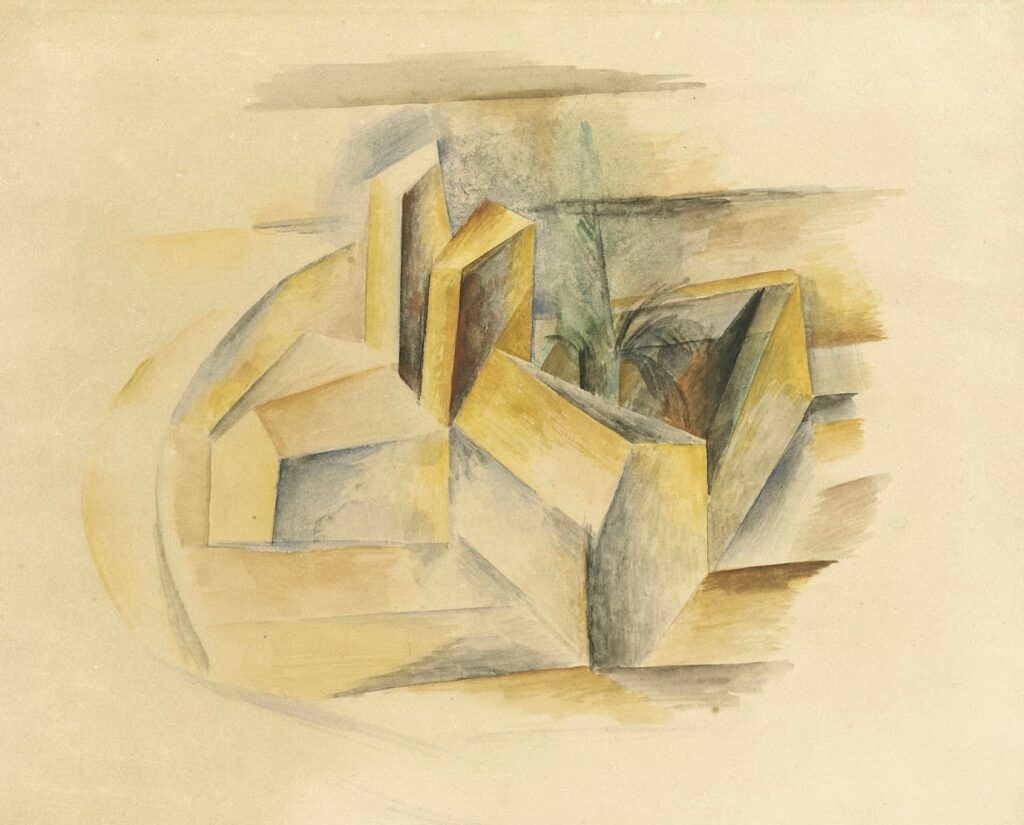
In the first decade of the twentieth century, Picasso produced numerous watercolors. His 1909 The Mill at Horta is particularly revealing because it belongs to the period when he was developing the ideas that would eventually become Cubism.
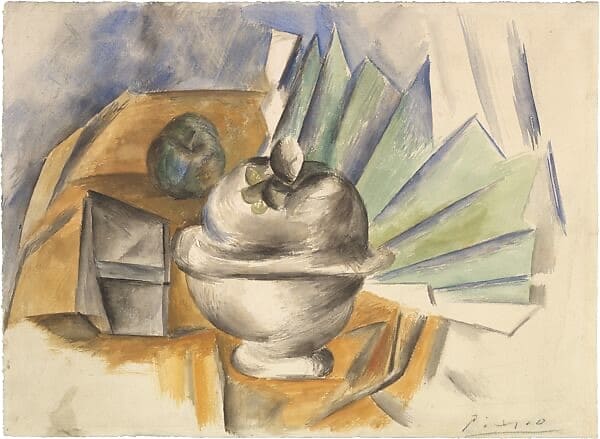
In his 1909 Sugar Bowl and Fan, the unfinished passages help emphasize the faceted planes associated with his early Cubist style. The transparency of watercolor also exposes the construction underneath. We can almost watch Picasso building the image.
For Picasso, watercolor was not simply about creating beautiful washes. It was a way of thinking with a brush.
Piet Mondrian: From Watercolor Landscapes to Abstract Art
Today, Piet Mondrian is one of the most recognizable names in abstract art. His mature paintings boast black horizontal and vertical lines, white spaces, and rectangles of red, yellow, and blue. But before Mondrian became one of the most important figures in abstract art, he was a landscape painter. And watercolor played an important role in that transformation.
Mondrian’s Concept of Abstract Reduction
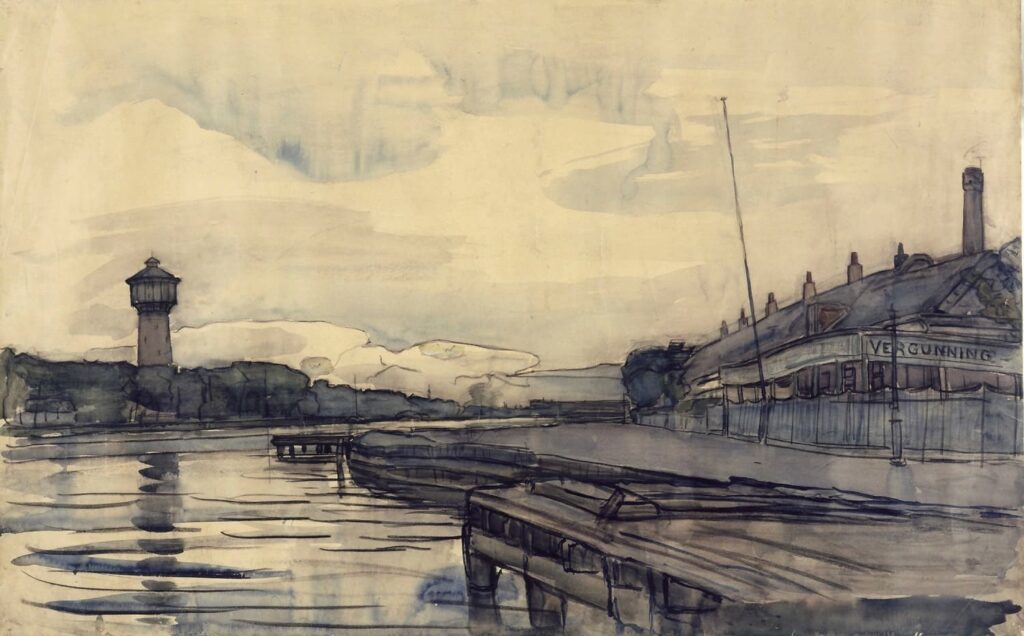
Consider Amstel River from 1907, a watercolor and charcoal drawing on paper. At this point in his career, Mondrian was looking closely at nature: trees, water, sky, and architecture. But even here, something is changing. He simplifies what he sees. Mondrian doesn’t describe every leaf, branch, or ripple. Instead, he reduces the landscape to broad areas of tone and color.
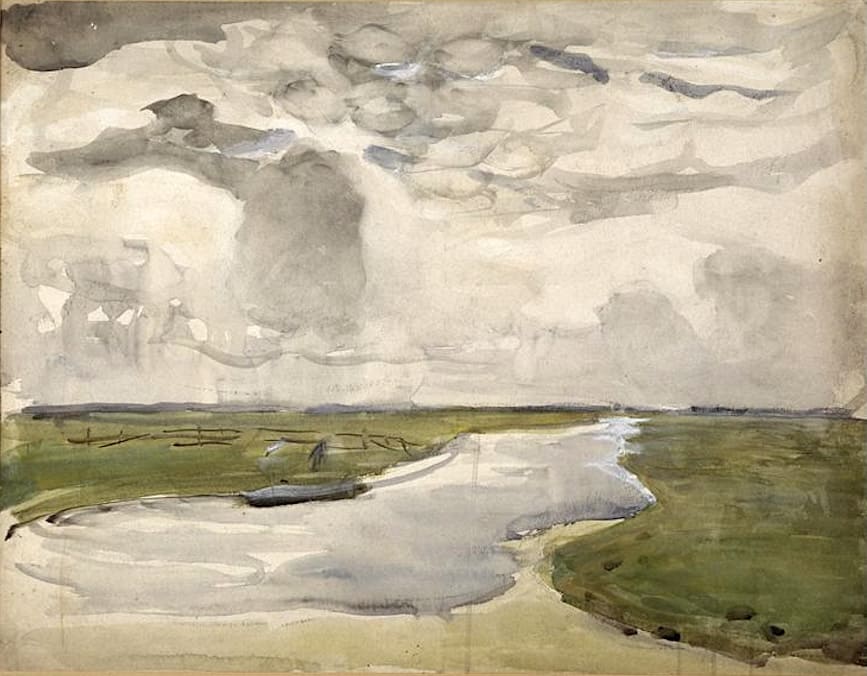
That is one of the great strengths of watercolor. You don’t have to describe everything. A transparent blue wash suggests an entire sky. A few dark strokes become a tree. A patch of color suggests water reflecting light.
Mondrian eventually took this process of reduction much further. The tree became a vertical line. The horizon became a horizontal line. Natural color became an organized system of primary colors.
This progression is important to understanding modern art history. Mondrian’s abstraction did not appear out of nowhere. It developed through years of observation, simplification, and reduction. His early watercolors show an artist discovering that a powerful image can leave things out. The blank paper matters. The space between shapes matters. A few carefully placed marks organize an entire composition.
So when you look at a mature Mondrian and see a seemingly simple grid, remember the watercolor landscapes that came before it. The path from landscape painting to abstract art was a gradual process of seeing, simplifying, and reducing.
Jackson Pollock: Watercolor and the Power of the Mark
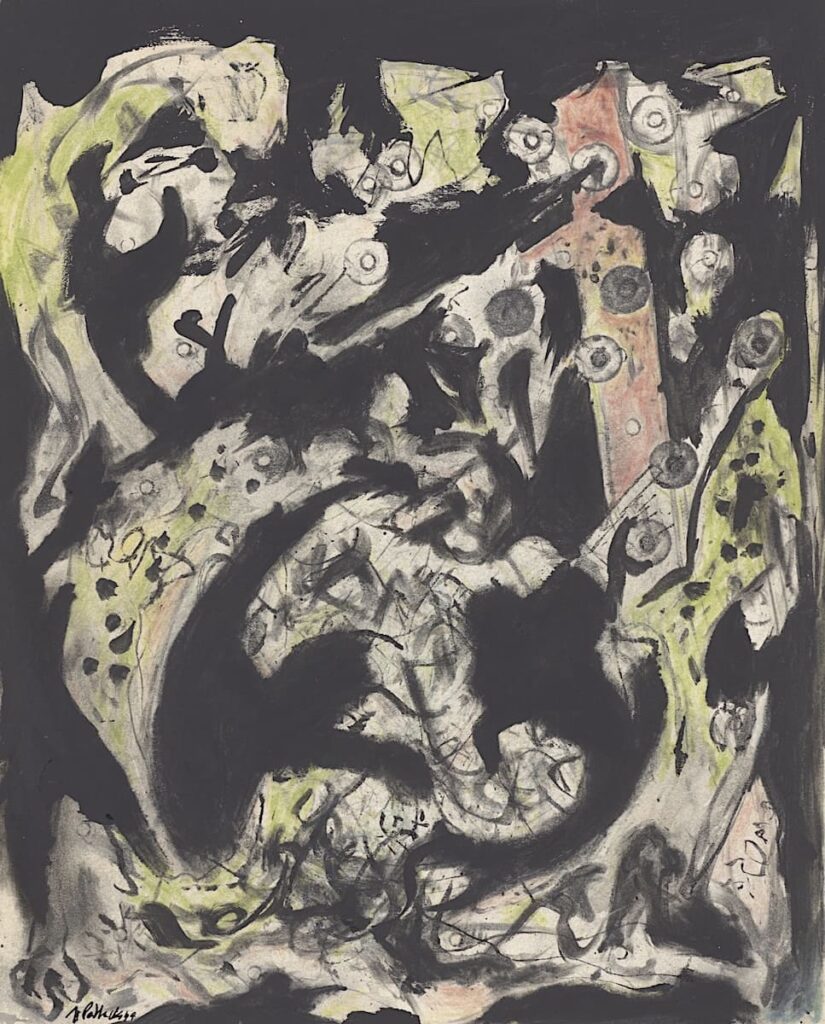
Jackson Pollock is one of the most famous artists in modern art history, best known for his poured and dripped paintings. Watercolor isn’t the medium most people associate with Pollock. Yet he created important works on paper using watercolor, gouache, and ink.
His 1944 Untitled, combines watercolor, gouache, and ink. Pollock uses transparent watercolor alongside black gouache—the opaque form of watercolor—to create a striking interaction between light and dark.
This tells us something important about his approach to modern art. Pollock wasn’t interested in watercolor simply because it was delicate. He was interested in what the medium could do with a mark, and found that different kind of marks can coexist.
Watercolor as a Forerunner to Pollock’s Famous Drip Paintings
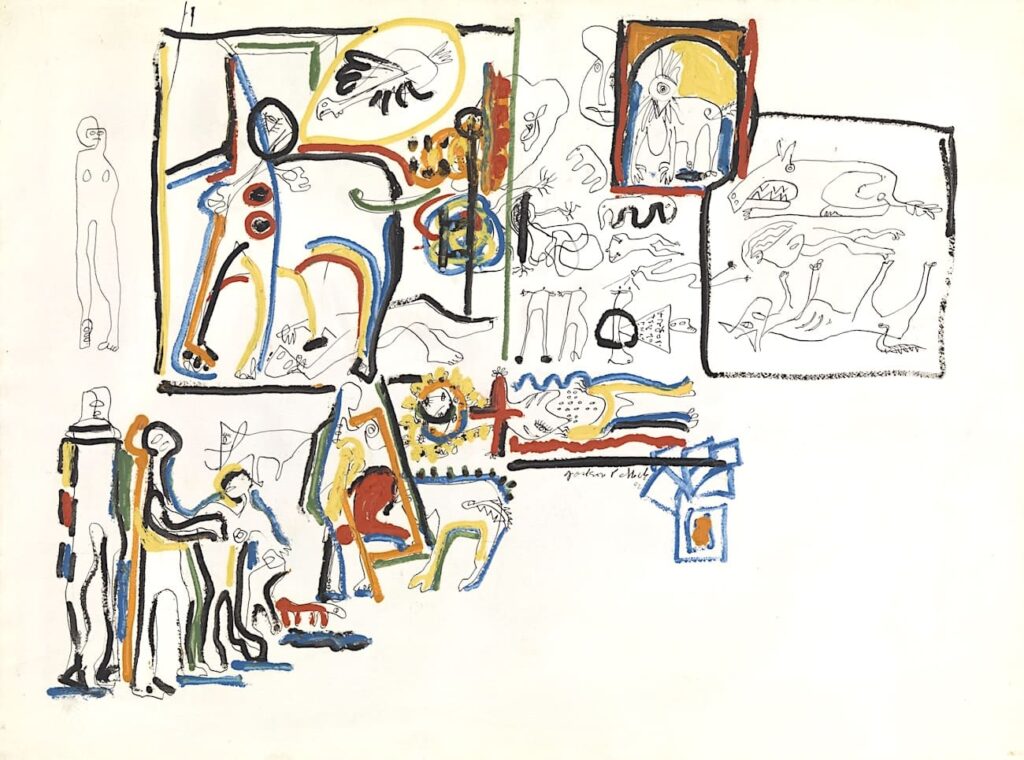
In Untitled Animals and Figures, Pollock combined gouache and ink, layering vibrant lines over loosely drawn figures and animals. These works reveal his continuing interest in bringing different layers, gestures, and marks together. That same concern became central to his later drip paintings.
Pollock’s technique wasn’t simply about throwing paint around. He built his paintings around interactions between line, splash, drip, gesture, density, transparency, and opacity. His works on paper help us see the connection between drawing and painting in his artistic development.
For Pollock, the mark itself is the subject. And this idea is fundamental to the history of abstract art.
Wassily Kandinsky: Watercolor, Abstraction, and Music
If any artist seems naturally suited to watercolor, it is Wassily Kandinsky.
Kandinsky is one of the defining figures in the history of abstract art. He believed painting communicates something beyond the visible world. He wanted color and form to express emotions, sensations, and inner experience. Watercolor gave him a remarkably direct way to explore those ideas.
Kandinsky’s Connection Between Watercolor and Music
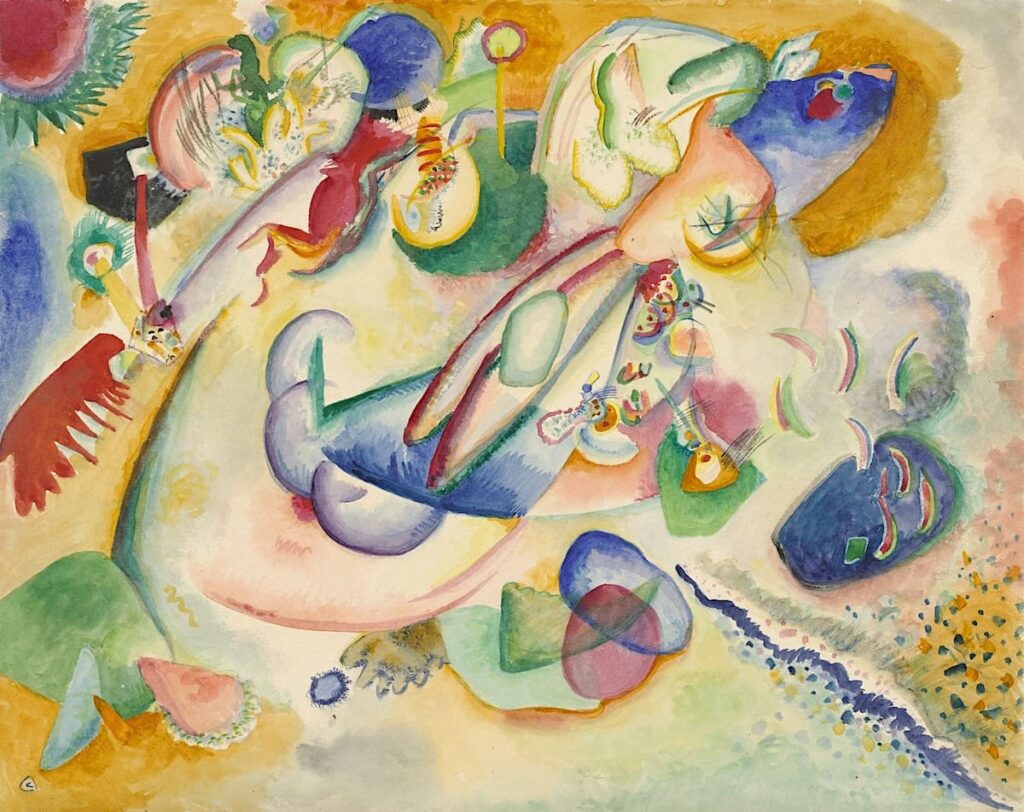
In 1914, Kandinsky created Improvisation, a watercolor and pencil work on paper. The title is revealing. Kandinsky frequently used musical language to describe his art, and watercolor has something in common with musical improvisation. It moves quickly. A stroke is spontaneous. Colors bleed into one another. A line responds to what happened only moments before. Rather than carefully constructing every form, the artist reacts to the movement of the paint itself.
Kandinsky was deeply interested in the relationships between color, shape, and movement. In his earlier works, traces of landscapes and figures are recognizable. But gradually, recognizable objects dissolve. Lines are independent. Circles, triangles, patches of color, and energetic marks occupy the paper on their own. This is one of the key developments in modern art history: the gradual movement away from representing the visible world and toward making color, shape, and line independent subjects.
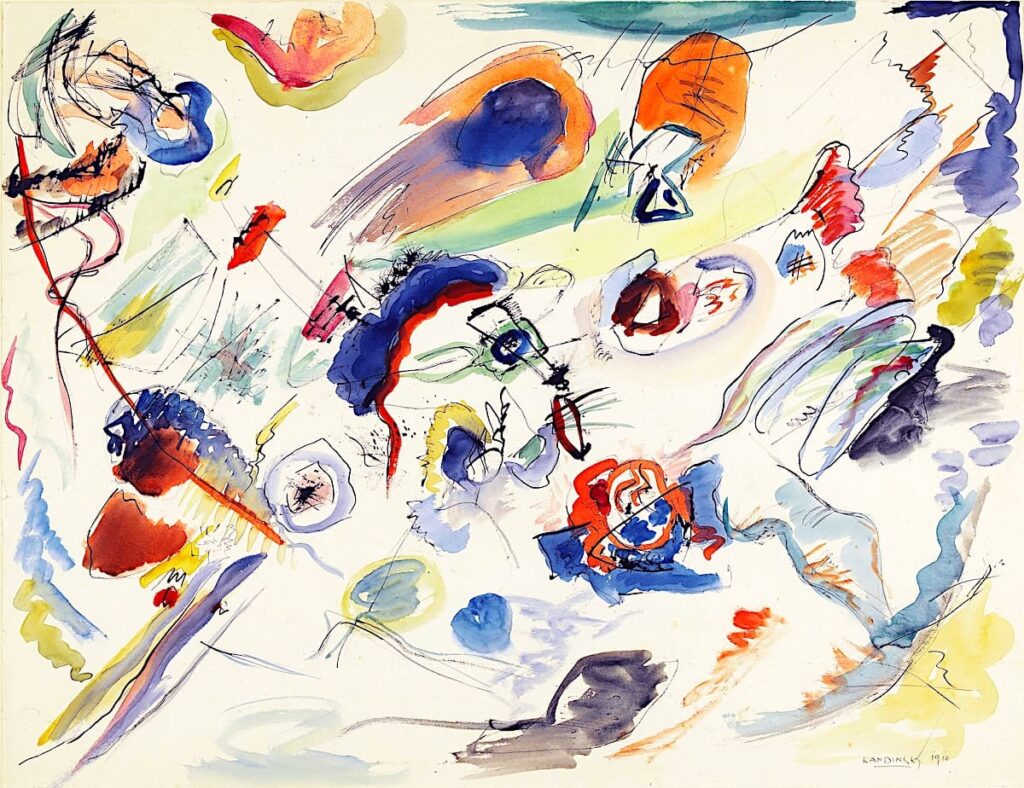
Watercolor’s transparency became part of Kandinsky’s visual language. Color doesn’t simply sit on top of the paper, it seems floating within it. In some of his later watercolors, Kandinsky combined transparent watercolor with gouache, contrasting luminous passages with more solid shapes.
For Kandinsky, watercolor wasn’t merely a preparatory medium. It was a language of color, rhythm, transparency, and movement.
Marc Chagall: Watercolor and the Dream of Modern Art
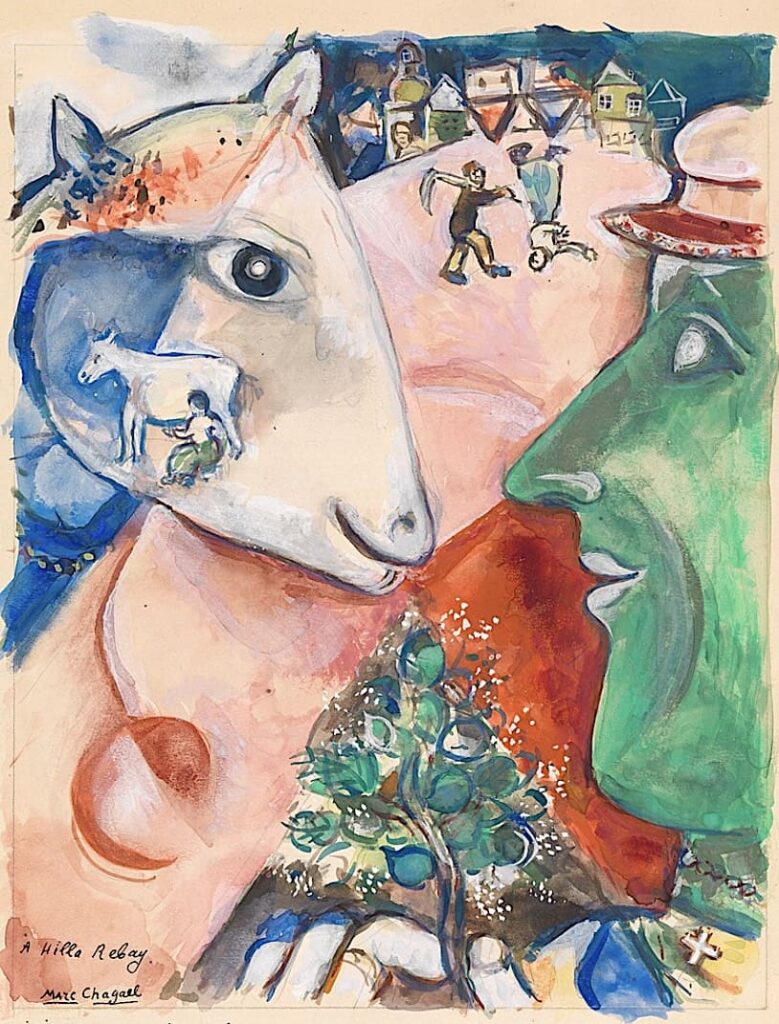
Marc Chagall’s paintings exist somewhere between memory and dream. People float. Animals appear in impossible places. Musicians hover above villages. Lovers embrace in the sky. Chagall is among the famous artists of modern art whose work demonstrates how color communicates emotion rather than simply describing reality. Watercolor was particularly well suited to this visual world.
Chagall created watercolors as independent works, but he also used watercolor and gouache for designs connected with theater and ballet. His designs for the ballet Aleko combine watercolor, gouache, and pencil.
Chagall’s Mixed Media of Watercolor, Gouache, and Pencil
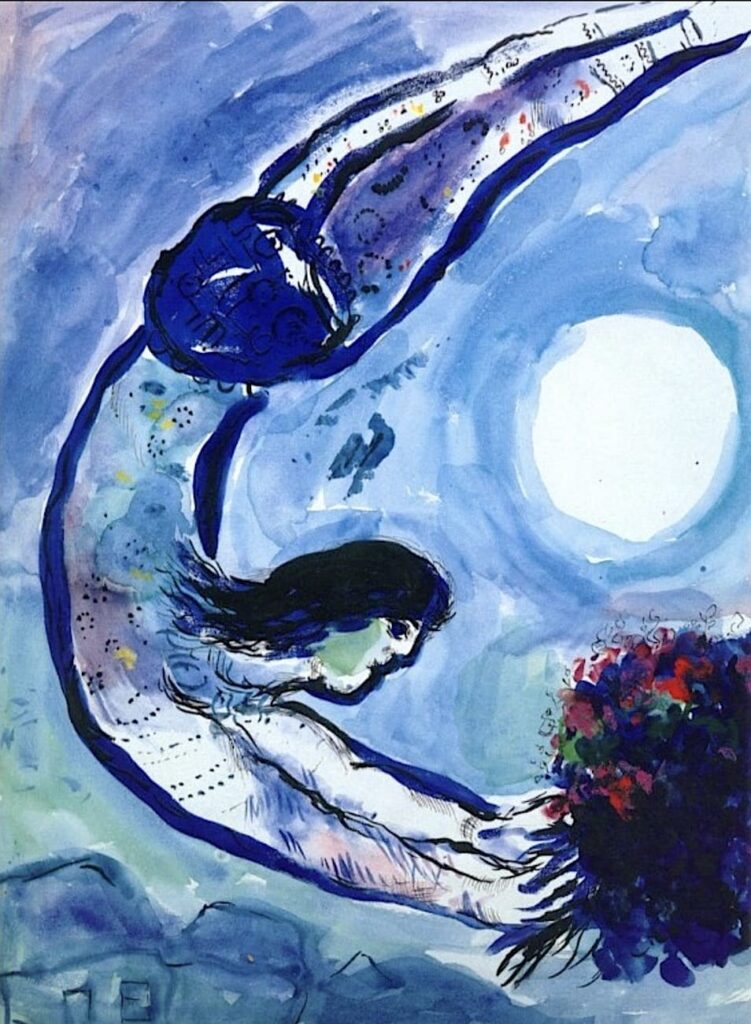
That combination gave Chagall tremendous flexibility. Watercolor provided transparent washes. Gouache created opacity. Pencil produced line. Together, these materials allowed him free movement between drawing and painting.
That flexibility fits Chagall’s imagery beautifully. His figures appear solid one moment and almost weightless the next. A blue wash becomes night. A red shape becomes emotion. A few loose marks suggest an entire village.
Watercolor preserves this sense of immediacy. It doesn’t completely seal the image beneath a heavy surface. You still sense the paper and the artist’s hand. That makes Chagall’s dreamlike imagery strangely intimate—as though looking at a memory before it has fully solidified.
Why Did These Famous Artists Use Watercolor?
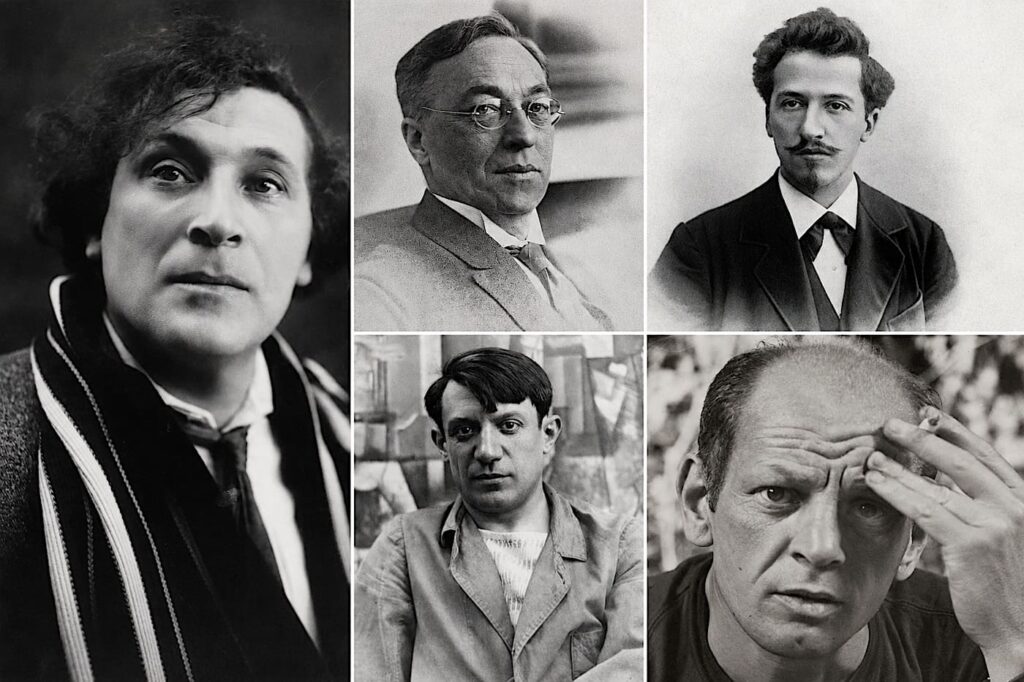
So why did these five famous artists turn to watercolor? The answer is different for each artist.
For Pablo Picasso, watercolor enabled experimentation—a quick way to test structure, color, and form.
Watercolor simplified the natural world for Piet Mondrian, transforming observation into economical arrangements of shape and color.
For Jackson Pollock, watercolor provided a way to experiment with gesture, layering, transparency, and the expressive power of the mark.
Watercolor offered spontaneity and luminous color for Wassily Kandinsky, perfectly suited to his attempt to make painting behave more like music.
For Marc Chagall, watercolor preserved the fluid, intimate, dreamlike quality of his imagery.
But there is also a larger lesson here about modern art. We often talk about artists as though style comes entirely from imagination, yet style also comes from materials. Watercolor spreads, stains, and reveals the paper. The artist must make decisions quickly.
Those qualities encourage many of the characteristics we associate with modern art and abstract art: simplicity, spontaneity, transparency, experimentation, and the visible gesture.
Watercolor’s Place in Modern Art History
Looking at watercolor works by Picasso, Mondrian, Pollock, Kandinsky, and Chagall gives us a different way to understand modern art history. We don’t have to look only at the masterpieces hanging in museums or the iconic paintings that define each artist’s reputation.
Their works on paper reveal the experimentation happening behind the scenes. They show an artist testing an idea before developing it further—or pursuing possibilities that only exist because of watercolor’s particular qualities.
This is why watercolor deserves a more prominent place in the study of art history. It wasn’t simply a secondary medium used for sketches or studies. For these artists, watercolor become a testing ground, a language, or even a finished form of expression. And that makes these works more than interesting footnotes to the history of modern art. They help us understand how modern artists actually thought.
The Medium Is Part of the Message
The story of watercolor in modern art ultimately reveals something fundamental about artistic practice. A medium doesn’t simply carry an idea. It can shape the idea itself.
Picasso found experimentation.
Mondrian found reduction.
Pollock found gesture.
Kandinsky found spontaneity and rhythm.
Chagall found luminosity and dreamlike fluidity.
Each artist discovered something different in the same material.
That is the real magic of watercolor. It doesn’t simply add color to an idea. It changes the way the idea exists. And perhaps that is why the watercolor works of these famous artists are so valuable to our understanding of modern art, abstract art, and art history. When we look beyond the iconic masterpieces and examine the materials artists actually used, we see modern art in a different way.
The medium is part of the message.